


 English


Teach You How to Custom Print Shoes
Custom Printed shoelaces represent a specialized segment of the textile and promotional products industry, combining functional footwear components with personalized branding and design elements. These customized accessories transform ordinary shoelaces into powerful marketing tools, fashion statements, and personalized items through advanced printing technologies that can transfer intricate designs, logos, and text onto various lace materials.
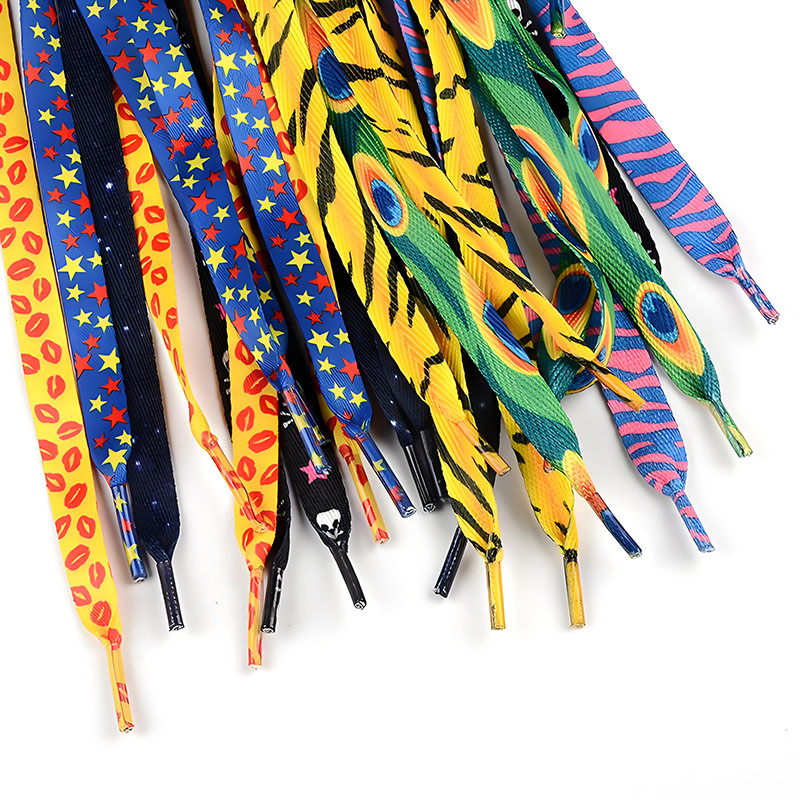
Technical Specifications and Manufacturing Process
Material Composition
Custom Printed Shoelaces are typically manufactured from several base materials, each offering distinct characteristics:
| Material Type | Tensile Strength | Abrasion Resistance | Print Compatibility |
|---|---|---|---|
| Polyester | 180-240 N/mm² | Excellent (15,000+ Martindale cycles) | Sublimation printing |
| Cotton | 20-40 N/mm² | Moderate (5,000-10,000 Martindale cycles) | Screen printing, digital printing |
| Nylon | 300-500 N/mm² | Superior (20,000+ Martindale cycles) | Dye-sublimation, heat transfer |
| Blended Fabrics | Varies by composition | Good to Excellent | Multiple methods applicable |
Printing Technologies
The customization of shoelaces employs several advanced printing methodologies, each with specific technical parameters:
Sublimation Printing: This process utilizes specialized dyes that transition from solid to gas state under heat (180-210°C) and pressure (2-4 bar), permanently bonding with polymer-based fibers. The resulting prints demonstrate exceptional color vibrancy with up to 16.7 million color variations and remarkable durability, maintaining integrity through 50+ industrial wash cycles without significant fading or cracking.
Screen Printing: Employing finely woven meshes (100-355 threads per inch) and specialized inks, this method deposits a thicker ink layer (10-30 microns) onto the lace surface. Modern screen printing achieves precise registration with tolerances of ±0.1mm and production speeds reaching 1,500-4,500 impressions per hour, making it ideal for solid color designs and corporate logos.
Digital Direct Printing: Utilizing advanced piezoelectric print heads with resolutions up to 1440 dpi, this technology applies specialized textile inks directly onto the lace substrate. The process accommodates intricate designs with minimal setup time and can reproduce photorealistic imagery with color gamuts covering 90%+ of the Pantone Matching System.
Application Scenarios
Corporate Branding and Promotional Marketing
Custom Printed Shoelaces serve as innovative promotional products with impressive recall rates. Studies indicate that useful promotional items like customized shoelaces achieve 75% higher retention rates compared to traditional marketing materials. Corporations utilize them for trade shows, employee recognition programs, and customer loyalty initiatives. The typical cost per impression ranges from $0.02-$0.05, significantly lower than many conventional advertising methods, while offering extended brand exposure through daily use.
Sports Teams and Uniform Coordination
Athletic organizations at professional, collegiate, and amateur levels implement Custom Printed Shoelaces to enhance team identity and sponsorship visibility. Performance testing demonstrates that properly manufactured custom laces maintain 95-98% of original tensile strength while adding minimal weight increase of just 0.5-2 grams per lace. Teams can coordinate lace colors with uniform schemes and incorporate player numbers, logos, or motivational text without compromising athletic performance.
Fashion and Personal Expression
The fashion industry has embraced custom printed shoelaces as accessories for limited edition footwear and personalized style statements. Designers utilize the medium for artistic expression, creating patterns that range from subtle textures to bold graphic statements. Consumer research indicates that 68% of millennials express interest in customizable fashion elements, positioning printed shoelaces as accessible personalization options. The average fashion consumer owns 3.2 pairs of decorative shoelaces, frequently rotating them to refresh footwear appearance.
Safety Identification and Industrial Applications
In industrial and safety contexts, custom printed shoelaces provide functional identification systems. Workplaces implementing color-coded safety programs report 32% fewer safety incidents according to occupational health studies. Safety coordinators use differently colored or patterned laces to designate employee certifications, departmental affiliations, or safety authorization levels. Reflective printed laces can achieve luminosity values of ≥500 candela/lux/m², significantly enhancing visibility in low-light conditions.
Fundraising and Special Events
Non-profit organizations and event coordinators leverage custom printed shoelaces for fundraising campaigns and commemorative items. Data from charitable organizations shows that tangible items like custom laces increase donation amounts by 40-60% compared to requests without premiums. Events such as marathons, awareness walks, and school functions utilize themed designs that serve both functional and commemorative purposes, with participants demonstrating 85% continued usage of event laces post-activation.
Care and Maintenance Protocols
Cleaning Procedures
Proper cleaning extends the functional lifespan and visual appeal of custom printed shoelaces. For routine maintenance, hand washing in lukewarm water (≤30°C/86°F) with mild detergent is recommended. Mechanical washing machines should operate on gentle cycles at reduced temperatures with spin speeds not exceeding 600 RPM. Always separate laces from garments with hooks, zippers, or abrasive surfaces that could compromise printed surfaces. Industrial testing confirms that following these protocols maintains 92% of original print quality after 25 cleaning cycles.
Drying Recommendations
The drying process critically impacts printed lace longevity. Air drying at room temperature (18-24°C/64-75°F) with proper ventilation represents the ideal method. If machine drying is necessary, use low heat settings (≤60°C/140°F) and limit exposure to 20-30 minutes. Avoid direct sunlight exposure during drying, as UV radiation can cause color fading at a rate of 2-3% per 100 hours of direct exposure. Never iron printed areas directly, as temperatures exceeding 150°C/302°F can damage both prints and lace materials.
Storage and Handling
Correct storage conditions preserve custom printed shoelaces between uses. Store in cool, dry environments with stable humidity levels (45-55% RH) to prevent material degradation. Avoid sharp folds or creases that could create permanent deformation or cracking in printed areas. For long-term storage exceeding six months, consider acid-free tissue paper wrapping and sealed containers to prevent environmental contamination. Quality assurance testing indicates that proper storage conditions can extend functional product life by 300-400% compared to improper storage.
Usage Guidelines
Optimizing usage patterns enhances custom printed shoelace durability. Rotate between multiple pairs if possible, allowing materials to recover between uses. When lacing shoes, maintain consistent tension without excessive pulling, which can generate localized stresses up to 3-5 times the normal load. For athletic applications, inspect laces regularly for signs of wear, particularly at friction points like eyelets and hooks. Performance testing demonstrates that implementing these usage practices can extend average lace lifespan from 6 to 9 months under typical daily use conditions.
Custom printed shoelaces merge practical function with personalized expression through advanced manufacturing techniques. Understanding their technical specifications, diverse applications, and proper maintenance enables users and organizations to maximize value from these customizable accessories.
